On this page
Telehealth care is available in Arizona, Florida, Illinois, Indiana, Kentucky, Michigan, Nevada, and New York. You must be in your selected state during the visit.
You wake up with a scratchy throat. Your first thought: Please don’t let this be strep throat.
And if it is, you wonder almost immediately when you’ll start feeling better and what you need to do next.
If you’re amongst those who’ve stayed awake at night wondering about strep throat and just how contagious it is, it really is something that can keep many people up at night (literally, because it does make sleeping pretty miserable).
Let’s break everything down about strep throat contagion. That way, you can make a smart health choice and keep those you love safe.
What Exactly Is Strep Throat?
Before discussing how contagious it is, let us take a look at what we are working with.
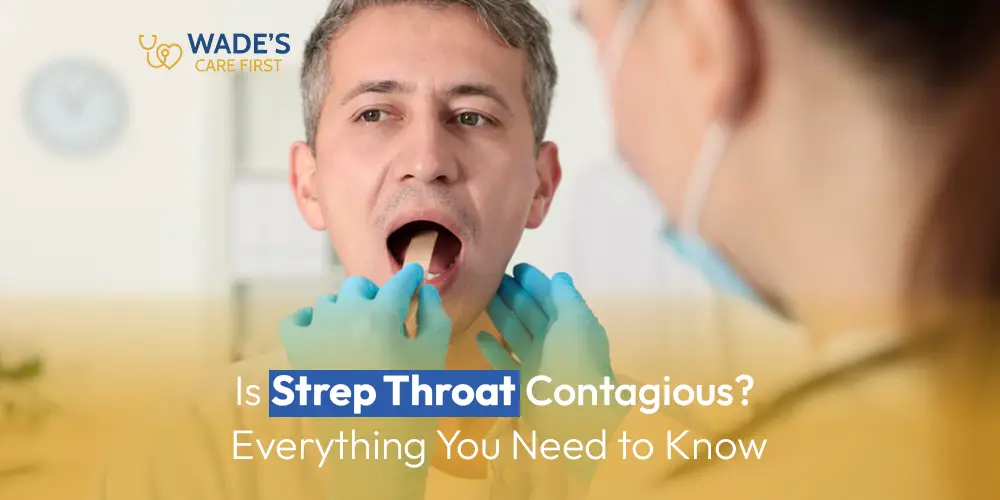
It is not just any sore throat. It’s a certain bacterial infection, namely those caused by the group A Streptococcus type of bacteria.
Most sore throats are caused by viruses. Strep throat is caused by group A Streptococcus bacteria and may require testing to confirm.
Therefore, it is sensitive to antibiotics yet has its own peculiar mode of spreading.
The key difference is important. While viral sore throats are very common and generally mild, strep throat packs more of a punch, which comes with:
- Severe throat pain makes swallowing difficult
- Red and swollen tonsils, with white patches in some cases
- Fever, often over 101°F
- Swollen lymph nodes in your neck
- A headache and body aches
How Contagious Is Strep Throat?
Strep throat is very contagious, but you can control it.
The bacteria are spread by respiratory droplets.
When a person with strep coughs, sneezes, talks or even breathes on you, self-contained droplets filled with the bacteria travel the air.
Strep bacteria can spread through respiratory droplets and contact with infected secretions. Distance alone does not eliminate transmission risk.
This is how it spreads so easily in households, schools, or at places of work when people are in close contact.
Strep throat is different from some other contagious conditions in this: it spreads through direct contact.
Infection is caused by sharing drinks, utensils, touching surfaces that someone who has strep has touched, etc.
When Are You Most Contagious?
The contagious period for strep throat is a pretty predictable pattern.
- Without treatment, strep can continue to spread. Arrange appropriate assessment and testing rather than relying on a fixed contagious period.
- With appropriate antibiotics, transmission risk decreases. Stay home until you are fever-free and have taken the prescribed antibiotic for at least 12–24 hours, following your clinician’s advice.
The 24-Hour Rule Everyone Should Know
Resting at home is the best thing to do.
Stay home until you are fever-free and have taken appropriate antibiotics for at least 12–24 hours, following your clinician’s advice and school or workplace requirements.
Who’s Most at Risk?
Strep throat is something that anyone can get. There are, however, people at a greater risk.
Knowing this helps in making proper decisions in terms of exposure and prevention.
Higher Risk Groups:
- Children ages 5-15
- People with compromised immune systems
- Close contact with those in dorms or military barracks
- Healthcare workers and teachers
- Parents and caretakers of young children
Why Kids Get It More:
Children are not only more likely to get strep throat but also to pass it around.
They touch everything, don’t cover their mouth or nose well, aren’t the tidiest at cleaning up, and spend much of their time near other kids.
If you’re a parent, you’ve surely noticed that when one child in the class gets strep, it usually goes around.
Prevention Methods That Work
Such strategies are effective if used consistently.
At Home:
- No sharing drinks, utensils, or personal items
- Frequent handwashing, especially before eating
- Do not share toothbrushes, drinking glasses or eating utensils.
- Clean frequently touched surfaces regularly
- Stay a bit far from family members when they are sick
In Public Spaces:
- Try not to be in a close contact with an ill person
- Wash hands after contact with common surfaces
- Avoid touching your face particularly your mouth and nose
- Take hand sanitizer to use when you cannot wash hands
What About Recurring Strep Infections?
Some people carry group A strep without symptoms. A positive test in a carrier is different from repeated symptomatic strep infection; a clinician can interpret the results in context.
If you or someone in your family has recurring cases of strep, here are a few possibilities.
Sometimes, people can have strep bacteria but not have any symptoms of strep, they are referred to as “carriers.”
People who carry group A strep without symptoms are less likely to spread it and usually do not need antibiotics. A clinician should interpret positive tests in the context of symptoms.
In some cases, the infection has been not fully cured by the treatment, or there are factors that predispose one to reinfection.
Discuss recurring sore throats with a clinician. Testing of household members is based on symptoms and the clinical situation rather than automatically testing everyone.
Other Ways Strep Can Affect You
Seeing as we are talking about how easily it can spread, strep can at times cause more trouble than just a sore throat.
In some cases, the untreated strep infection may complicate/develop into a more serious systemic disorder including rheumatic fever or even affecting the kidney.
The early intervention assists in safeguarding you as well as those around you.
When to Get Medical Care
Strep throat is bacterial and requires antibiotics, which is why a visit to a healthcare provider is normally crucial.
But when should you make that appointment?
You should go in if you have:
- Severe sore throat that makes swallowing very difficult
- Fever over 101°F
- Swollen lymph nodes in your neck
- Red, swollen tonsils, especially with white patches
- Symptoms that aren’t getting better after a couple of days
Having a test done is the only way of knowing for sure if you have strep throat.
The rapid strep test takes just a few minutes and can give you answers quickly.
The Bottom Line
The key points:
- Transmission risk decreases with appropriate treatment, but symptoms and clinician guidance still matter.
- Appropriate antibiotics reduce transmission; return to usual activities when fever-free and after at least 12–24 hours of treatment, as advised.
- The 24-hour rule might help others not get infected
- Total prevention can significantly decrease your chances of getting or spreading strep
Most importantly do not panic if you think you might have strep throat.
Soon enough, with proper medical care, you will feel fine.
Wade’s Care First Can Help
We offer urgent care services and treatment for strep throat and other respiratory illnesses at Wade’s Care First.
An experienced health care team is here to give you the time and the caring attention you require to get on your way to feeling yourself again.
Whether it’s treatment for the symptoms that just won’t quit, or information on keeping your family from getting it in the first place, we can help you.
Book Your Appointment Today
If you’re in Arizona, Florida, Illinois, Indiana, Kentucky, Michigan, Nevada, and New York and think you may have strep throat, don’t wait for symptoms to get worse or risk spreading it to others.
Answers connected to this topic.
Can a sore throat be assessed without an in-person examination?
We can review symptoms and risk factors by video, but a strep or other test may be needed before deciding on treatment.
Can I ask about school attendance after an illness?
Yes. We can discuss symptom recovery and general return-to-school considerations, with documentation only when supported by the clinical assessment.
Can you reassess an illness if my symptoms worsen after a video visit?
Yes, but rapidly worsening or severe symptoms should be evaluated promptly in person rather than waiting for a routine follow-up.
Further reading: cdc.gov.