On this page
Telehealth care is available in Arizona, Florida, Illinois, Indiana, Kentucky, Michigan, Nevada, and New York. You must be in your selected state during the visit.
It is easy to think sun protection is only needed at the beach or by people who burn easily.
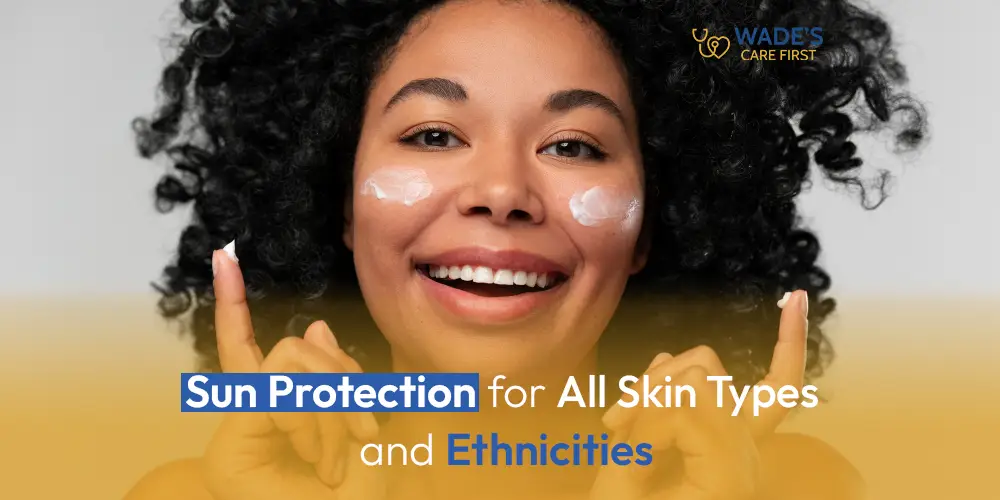
People of every skin tone need protection from the sun.
Although a darker color of skin does offer a certain degree of protection in that it is more natural, yet it still needs protection against the UV rays!
It is necessary to make sure that we are safe in the sun. Not only in summer but all year round.
At Wade’s Care First, our focus is on helping you understand how to keep your skin healthy. Let’s take a closer look at what that means for you.
- Anyone can get sun-damaged, even when you do not see any blistering
- The accumulation of such risks is low and slow, such as hyperpigmentation, premature aging, and even skin cancer
- Doing the right things today equates to healthier skin tomorrow
Here’s Why Sunscreen Is Important for Everyone
When it comes to sunlight, here’s what’s really going on:
- UVA rays. Lead to aging, dark spots and wrinkles
- UVB rays. Produce burning and more noticeable immediate damage
- Both may lead a person to larger issues, such as skin cancer, in the long run
- UV rays penetrate clouds, and the protection is essential not only in summer
Darker skin is still vulnerable to:
- Uneven skin tone and spots
- Signs of aging
- Skin cancers that can go undetected
Choosing Sunscreen: What to Look For
Picking sunscreen shouldn’t be stressful. The following are the fundamentals that should be sought:
- Select a sunscreen with the label of broad spectrum. Something that covers both UVA and UVB
- Select an SPF of 30 or higher that will provide everyday protection
- Sunscreens containing zinc oxide or titanium dioxide may suit sensitive skin, but any product can cause irritation. Choose broad-spectrum SPF 30 or higher and use it as directed.
- Chemical sunscreens can be lighter and easier to apply, but may irritate people with very sensitive skin
- New formulas are out there for deeper skin tones to avoid white residue. Look for tinted versions or sheer options
Other handy sun-safe habits:
- Reapply every two hours if you’re spending time outside
- Don’t forget about spots like the ears, neck, scalp, and hands
- Sunglasses and hats add even more protection
Culturally Sensitive Dermatology
No two people or routines are quite the same. At Wade’s Care First, you get:
- Conversations that start with your concerns
- Tips that actually fit your lifestyle, habits, and cultural preferences
- Support for questions about:
- Acne and dark spots
- Sunscreen products that feel good and look invisible
- Making sun protection a natural part of your mornings
Charles Wade, FNP-BC, is dedicated to empathetic, collaborative, and practical care.
We are not here to provide temporary solutions but to assist you in developing long-term routines.
Related: How Wade’s Care First Helps You Stay on Top of Your Health with Primary Care
Keeping Your Skin Healthy, Long Term
Every day, sun protection is among the simplest methods of looking after your skin, irrespective of your age or the color of your skin. Some basics to keep in mind:
- Wear sunscreen on a daily basis in the morning! Even when you just need to go to the car or the mailbox
- Reapply it if you’re going to be outside a long time or after swimming
- Accessories (sunglasses, hats and sleeves) and shade matter as well
Minimal actions bring long-term rewards. Wade’s Care First can give you personalized life and skin advice.
Book your telehealth appointment today. We provide same-day appointments when available in Arizona, Florida, Illinois, Indiana, Kentucky, Michigan, Nevada, and New York.
FAQs
Do all ethnicities need sunscreen?
Yes. The sun can damage the skin of all colors! Everyone needs sunscreen on a daily basis.
What is the best sunscreen for all skin types? Choose a water-resistant sunscreen with SPF 30 or higher and broad-spectrum protection against both UVA and UVB rays. Pick a formula you are comfortable using consistently.
Further reading: American Academy of Dermatology: Sunscreen FAQs.
Answers connected to this topic.
Is melasma the same as post-inflammatory dark spots?
Not necessarily. Several conditions cause pigmentation changes, and treatment depends on the likely diagnosis. Sun protection is often an important part of care.
Can a changing mole be managed with a topical cream?
A changing or bleeding mole should be examined in person, often by a dermatologist. Telehealth cannot rule out skin cancer or replace a biopsy.
Further reading: aad.org.